THE
ORIENTAL INSTITUTE OF THE UNIVERSITY OF CHICAGO
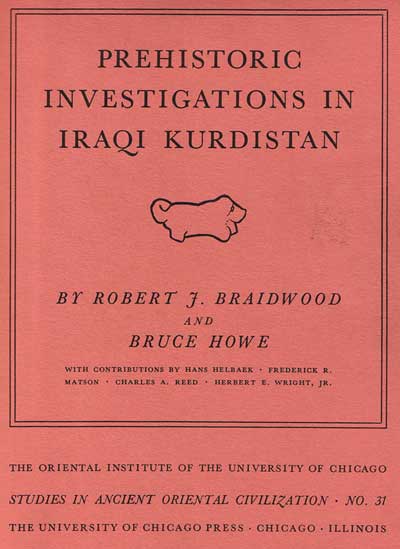
STUDIES IN ANCIENT ORIENTAL CIVILIZATION - NO 31:
PREHISTORIC
INVESTIGATIONS IN IRAQI KURDISTAN
This is the story of the first three field campaigns of the 8 years long archeological expedition to Iraqi Kurdistan /Jarmo Project/ in the Kurdish hill country of Tigris & Eufrat between years 1952-1959
THE
ORIENTAL INSTITUTE OF THE UNIVERSITY OF CHICAGO
STUDIES IN ANCIENT ORIENTAL CIVILIZATION - NO 31
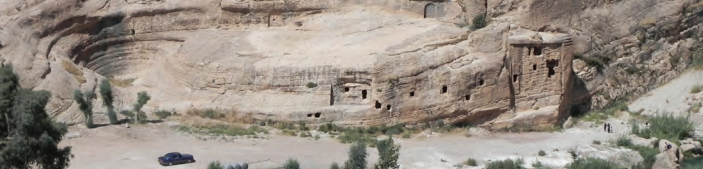
Near Eastern Archaeology, September 2017, "The Archaeological Renaissance in the Kurdistan Region of Iraq" by Jason Ur (Harvard University).
After an absence of over two decades, foreign archaeology has returned in earnest to one of the “cradles of civilization” in the Kurdistan Region of Iraq. Two wars, international sanctions, and internal unrest had together brought archaeological research nearly to a standstill; only a few under-funded Iraqi teams and a handful of intrepid Europeans attempted fieldwork following the first Gulf War of 1991. Following a decline in political violence that began in 2008, archaeologists have returned to the Republic of Iraq. The resumption of fieldwork in the southern “heartland of cities” has been significant but slow, and hampered by internal politics. In the autonomous Kurdistan Region, however, foreign research has expanded rapidly and continuously, in partnership with local archaeologists and institutes. This essay reviews these new developments, discusses how the new discoveries are challenging long-held ideas and filling blank spaces on the archaeological map, and suggests some new directions for the future of Mesopotamian studies.
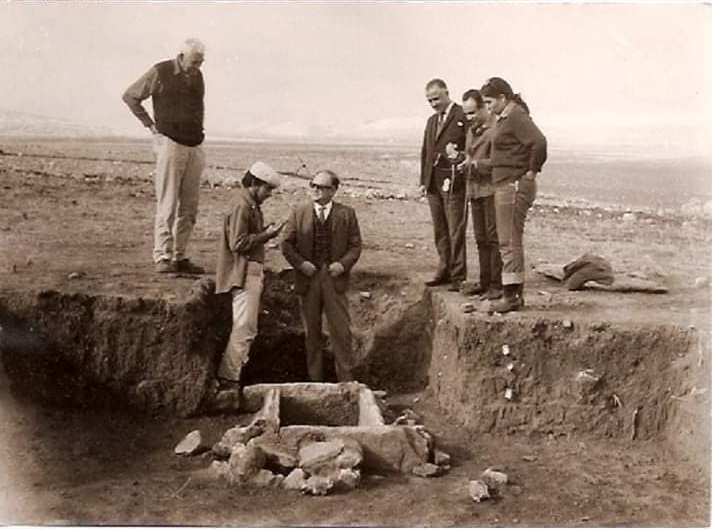
Kotê Berçem. (Çay Önü Ergani) - Amerikalı prof Mr James Braidwood (ayakta, kır saçlı), Diyarbekir sömürge valisi Ali Riza Yardanakul (kravatlı).
Ana rahminde olduğu gibi ayakları karınşarına doğru çekilmiş durumda gömülü bulunan insan mezarının başında. Foto: Mihemed Mercan
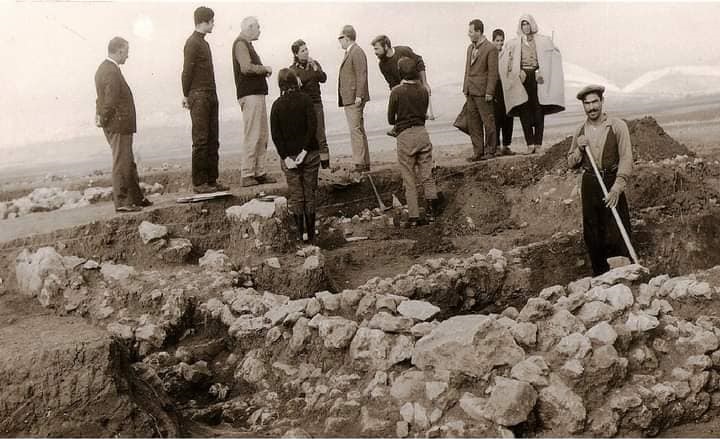
Kotê Berçem. (Çay Önü Ergani) - Kotê Berçem. (Çay Önü) - Amerikalı prof Mr James Braidwood (ayakta, kır saçlı),
Diyarbekir sömürge valisi Ali Riza Yardanakul (kravatlı).
Ana rahminde olduğu gibi ayakları karınşarına doğru çekilmiş durumda gömülü bulunan insan mezarının başında.
Foto: Mihemed Mercan Foto: Mihemed Mercan
Dikkat ederseniz kürd millî bilncinin oluşmasının önünü almak için kürd tarihini yok etmek amacıyla
işgalci türk devleti bu alanı da Heskîf ve diğer çay önü kültürü olan kürd tarihi sitelerini 1960'lardan bu yana
baraj projeleri uygulayarak sular altında bırakarak yok ediyor.
Dünyada ilk mozaik Çayönü kazılarında çok ilginç bulgular elde edildi. Çayönü Höyüğü ile yakınındaki Hilar köyündeki antik çağdan kalma mağaralar ve kaya mezarlarının varlığı aslında çok önceden, yüz yıl öncesinden biliniyordu. |
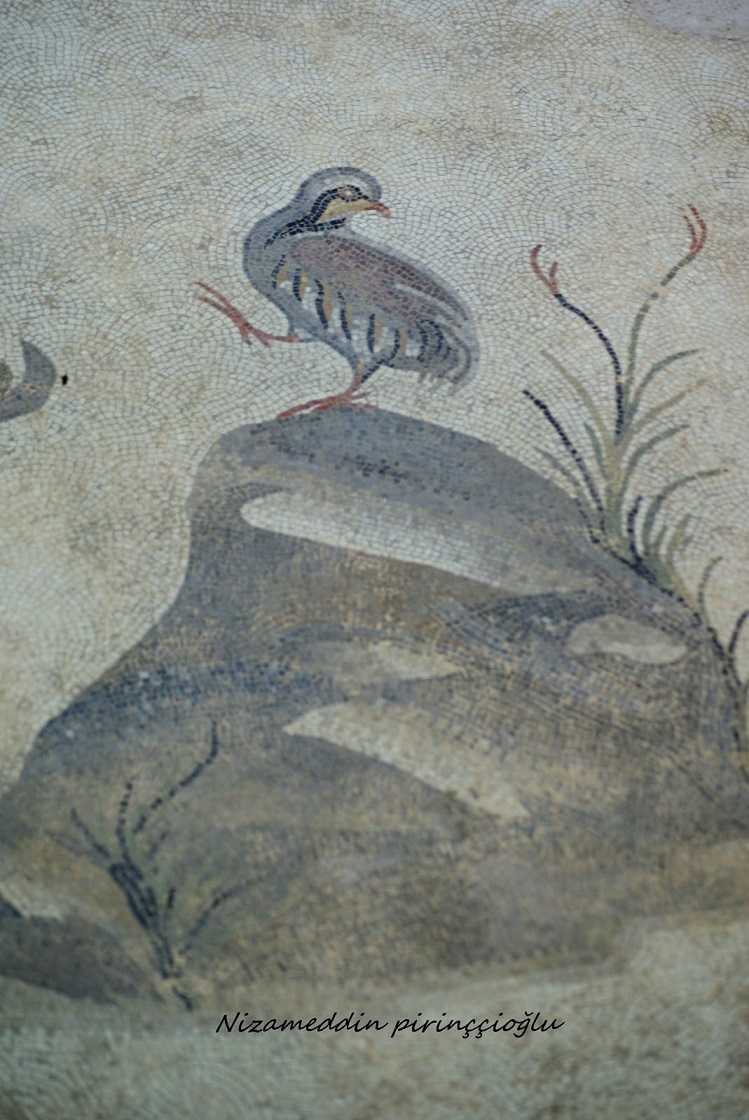
AD 300, 1700 years old Kurdish Mosaic still visible
Mozayikên Haleblibaxçe, Ruha
2020, Photo: Pirinccioglu
____________________________
Robert
Braidwood
1907 -
Born in Detroit, Michigan on July 29, 1907, Robert J. Braidwood was educated
at the University of Michigan and the University of Chicago where he studied
architecture, ancient history and anthropology. He is an anthropologist, archaeologist
and is a leader in the field of Near Eastern Prehistory; he is acclaimed for
his investigations into the origins and early consequences of a food producing
way of life. His research consisted of assembling problem-oriented interdisciplinary
teams involving the natural sciences.
In 1933, he earned his M.A. degree at the University of Michigan and joined
the University of Chicago Oriental Institute's Syrian Hittite Expedition on
the Amuq Plain, where he worked until 1938. In 1937, he married Linda and returned
to Chicago in 1938 to pursue graduate degrees. In 1943, he earned his Ph.D.
and began teaching for the Oriental Institute and the Anthropology Department
at the University of Chicago, where he remained until his retirement. Braidwood's
scholarly concern with food production developed in his early teaching career
and he did research on the shift from a hunting and gathering society to village
society. By drawing upon the writings of H.J.
Peake and H.J. Fleure as well as V. Gordon Childe, he set out to fill the gap
they had created.
In 1947, the Oriental Institute's Jarmo Project in Iraq was launched. It was
the first field project dealing specifically with retrieving evidence of the
methods of early food production and solving the ecological problem of its origin
and early consequences. On this project he employed archaeologists as well as
natural scientists who reconstructed the ancient environment.
The project was a challenge for Braidwood.; He began by using Childe's "Oasis
Theory." Then, based on the archaeological and paleo environmental evidence
they gathered, he formulated his; "Nuclear" or "Natural Habitat
Zone Theory." This theory was outlined in the book Prehistoric Investigations
in Iraqi Kurdistan. In 1950, his political problem in Iran had come to an end
even though the project had been moved to Iranian Zagros. From this site it
was discovered that occupation of the area dates back to the end of the Pleistocene
which inspired natural scientists to investigate climatic and vegetational history.
In the early 1960s, the University of Istanbul-University of Chicago's joint
effort was co-directed by Braidwood and Professor Halet Cambel. From 1963 to
1988, there was a lot of productive fieldwork in southeastern Turkey which reaffirmed
the value of team effort. Information on early village farming life and the
development of food production was gathered through the excavation of Cayonu
Tepesi which also addressed the origins of metallurgy and architecture.
Braidwood was active in several professional societies and received numerous
honorary degrees. In 1971, he was awarded the title of Distinguished Lecturer
at the Annual Meeting of the American Anthropological Association. Braidwood
lectured and published many books and articles that have brought anthropology
and prehistory to the attention not only of historians of the ancient Near East
but also to the public. For more information please visit the University of
Chicago, Oriental Institute.
References:
Winter, Christopher, International Dictionary of Anthropologists. Garland Publishing,
New York & London, 1991.
Contemporary Authors
Dupuis, Diane L. . Gale Research Company, Detroit, Michigan 48226, Vol. 108.
Written by Students in an Introduction to Anthropology Class, Minnesota State University, Mankato, Minnesota 1998
THE
ORIENTAL INSTITUTE OF THE UNIVERSITY OF CHICAGO
STUDIES IN ANCIENT ORIENTAL CIVILIZATION - NO 31
NEOLITHIC BLADES FROM CHEMCHEMAL IN IRAQI KURDISTAN
HISTORICAL SITE & RUINS OF KURDISTAN